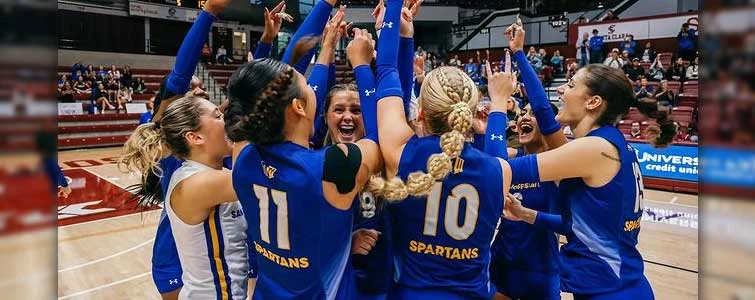
Southern Utah University and Utah State University were the first and fourth institutions to forfeit women’s volleyball matches against San Jose State University without explanation. Boise State and the University of Wyoming have also opted to forgo matches against SJSU.
USU released a brief statement announcing the cancellation of the October 23 match, simply stating, “Utah State University will not participate in its scheduled October 23, 2024, volleyball match at San Jose State University. The University will abide by Mountain West Conference policy regarding how this match is recorded.”
However, the underlying issue appears to center around Blaire Fleming, a transgender female athlete on SJSU’s team, as reported by San Francisco’s KRON4.
The controversy first came to light when SUU canceled its September 14 match against SJSU, with Boise State and Wyoming soon following. None of the universities explicitly cited the participation of a transgender athlete as their reason for forfeiture, but public statements and growing political support suggest the issue of transgender inclusion in women’s sports is at the heart of the matter.
Gov. Cox supports decision to forfeit
Utah Governor Spencer Cox, an alumnus of USU, made a statement on X, saying: “I stand with the students, coaches, and leadership at @SUUtbirds and @USUAggies in their decision to forgo their women’s volleyball matches against San Jose State. It is essential that we preserve a space for women to compete fairly and safely. Our female athletes are left grappling with this difficult issue because the NCAA has failed in its responsibility to protect female athletes and women’s sports.”

Utah State House Speaker Mike Schultz also applauded the universities for their actions, urging the NCAA to address the matter with urgency.
“It’s time for the NCAA to take action to protect our female athletes and preserve women’s sports,” he stated.
The growing political support mirrors that of other conservative states where government officials have pushed back against policies allowing transgender athletes to compete in women’s sports.
Lawsuit
This controversy is part of a larger national debate surrounding transgender athletes’ participation in women’s sports, an issue that has ignited passionate responses from various sides. Earlier this year, a lawsuit was filed by a group of female athletes challenging the NCAA’s policies that allow transgender women to compete in women’s collegiate sports.
Among the plaintiffs is former collegiate swimmer Riley Gaines, who has become a prominent figure in the fight to restrict transgender athletes from women’s competitions. Gaines praised USU’s decision to forfeit, saying on social media: “Major kudos to @USUAthletics. The gender ideology house of cards is crumbling, and it’s a glorious sight.”
SJSU Women’s Volleyball teammate Brooke Slusser joined the lawsuit, stating, “If I have daughters and I had to sit there and watch them play against a male player, or be on a team with a male player, and knowing that I could have done something about it and didn’t, I think that would be a really hard situation for me to end up in,” according to the ultra-conservative Fox News-owned Outkick, which describes itself as “exposing the destructive nature of ‘woke’ activism,” and “the antidote to the mainstream sports media that often serves an elite, left-leaning minority instead of the American sports fan.”
The lawsuit faces opposition from the American Civil Liberties Union and other human rights advocacy organizations.
“We feel called upon to defend against extremist attacks on our trans sisters – attacks that weaponize and distort the language of women’s rights to justify discrimination and bigotry,” Shiwali Patel, a director at the National Women’s Law Center, said in a news release. “Women athletes from across the country have voiced support for the inclusion of trans college athletes, including the iconic Billie Jean King, Megan Rapinoe, Sue Bird, and the reigning champion NCAA Women’s Basketball Coach Dawn Staley.”
“This lawsuit is not only an attack on trans women and girls–it’s an attack on all women and girls,” said Jennesa Calvo-Friedman, staff attorney for the ACLU’s Women’s Rights Project. “Policing who is, or isn’t, a woman subjects all women and girls to intrusive and humiliating scrutiny. In states across the country, we’ve seen cis and trans girls alike subjected to invasive questioning and harassment because their hair is too short, or they perform too well, to be considered ‘real girls.’ Women’s sports are critical because they provide freedom from pressure to comply with expectations about how women should look and behave, but this lawsuit diminishes that freedom and joy.”
NCAA’s transgender policy
The NCAA’s transgender student-athlete participation policy, updated in May 2024, determines eligibility on a sport-by-sport basis, aligning with the International Olympic Committee’s guidelines. For volleyball, USA Volleyball regulations dictate that transgender athletes can compete if they meet specific testosterone level requirements. Despite this policy, the growing number of forfeitures suggests that not all schools are comfortable with the current regulations.
As of now, the Mountain West Conference, to which both Utah State and San Jose State belong, has yet to comment on the series of forfeitures. Under conference rules, the matches forfeited by SUU, Boise State, Wyoming, and now Utah State, will be recorded as losses, benefitting SJSU’s undefeated record.
NCAA defers to the rules outlined by USA Volleyball. Any athlete who wants to compete as a gender different than the gender they were assigned at birth “must notify USAV of their intent at least six weeks prior to the competition in which they wish to participate. Sufficient documentation must be provided to permit the GC to determine that the applicant has taken the necessary steps to transition to their adopted gender.”
Three submissions are required:
1) a statement that the athlete wants to compete as a different gender;
2) a statement from their treating physician with medical records showing that they have taken steps to transition their gender;
3) lab reports of testosterone levels.
For transgender collegiate volleyball athletes, “testosterone levels must not exceed the upper limit of the normal female reference range for their age group,” which specifically means testosterone levels must be less than 10 nmol/L for a minimum of one year prior to their application being submitted to USA Volleyball.
Transgender advocates call it political
Equality California, an LGBTQ+ civil rights group, condemned the forfeiting universities’ decisions as politically motivated attacks from the right, unrelated to sports.
“Let’s be clear – this isn’t actually about sports; it is part of a coordinated nationwide attack on the LGBTQ+ community led by extremist right-wing politicians,” Equality California executive director Tony Hoang wrote. “School administrators’ decision to bow to pressure from extremists instead of allowing their student-athletes to compete harms all students involved. They are teaching fear-mongering and discrimination instead of fostering the camaraderie and competition college athletics should be about. Less than 2 percent of NCAA athletes identify as transgender or nonbinary. All trans athletes want to do is work hard and compete alongside their teammates — just like everyone else. Equality California stands with San Jose State University and appreciates their strong support for their student-athletes.”

Looking forward
SJSU implemented measures to ensure the safety of its women’s volleyball team as the program became a focal point in the broader debate over transgender athletes in sports.
According to SJSU spokesperson Michelle Smith McDonald, the team has been accompanied by additional security from university police for several weeks, both at home and on the road. McDonald highlighted that some social media activity targeting the team and university has been “unsettling,” emphasizing that student safety is the university’s top priority.
McDonald also clarified that while Boise State, Wyoming of the Mountain West, and Southern Utah forfeited matches against San Jose State, these are counted as victories by the conference but classified as “no contest” for NCAA Tournament purposes.
SJSU has 14 matches remaining in the regular season, plus the Mountain West tournament, and needs to play 19 matches to qualify for the NCAA Tournament. If further forfeits occur, it could jeopardize their postseason eligibility.
SJSU team played against Colorado State on Thursday, Oct. 3, losing its first match of the season in straight sets.
SJSU knows of no other cancellations on the horizon, the school’s senior communications director told Cowboy State Daily. The next team on the schedule, the University of Nevada-Reno, confirmed it will play the team, saying, “The University will continue to abide by the NCAA, Mountain West Conference and USA Volleyball rules and regulations as well as the laws and Constitution of the State of Nevada.”
.