

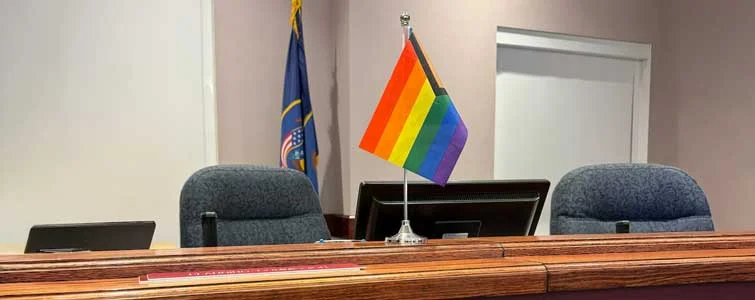
Utah Auditor clears Centerville council member’s Pride flag display, but fight may not be over
Utah’s state auditor has concluded that a small pride flag displayed by Centerville City Council member Cheylynn Hayman does not violate the state’s controversial flag-ban law, closing an inquiry that began after residents filed complaints against her.
Hayman, an employment attorney who has served on the council since 2024, has kept a small rainbow flag near her nameplate at council meetings for more than a year — a quiet but sustained protest against HB 77, the 2025 law that made Utah the first state in the nation to bar unsanctioned flags, including pride flags, from government buildings and schools.
In a letter sent late last month to Centerville Mayor Clark Wilkinson and the city manager, the auditor’s office wrote: “Based on Centerville City’s response, and other factors, the Office noted no violation of Statute.” The letter continued, “Therefore, the Office has concluded our inquiry into this matter. We appreciate your timely and cooperative response during this investigation.”
The finding validated the legal argument Hayman had been making since the state auditor first notified her in a May 22 letter that “multiple” complaints had been lodged. Hayman pointed to the specific language of Utah Code 63G-1-704, which restricts flag displays by “a government entity, or an employee of a school district or school within the public education system acting within the employee’s official duties.”
“The law only applies to government entities and school employees,” Hayman told the Standard-Examiner. “I am neither. This is something that I have done in my individual capacity. The city of Centerville as a government entity, has not engaged in any conduct. There has been no conduct by Centerville City that would violate this statute.”

She elaborated in her four-page written response to the auditor’s office, dated June 4: “In short, nothing in Section 704 prohibits publicly elected officials, separate and apart from the government entities they represent, from exercising their individual constitutionally protected First Amendment rights on government property, including by displaying pride flags on the city council dais in support of their constituents who are members or supporters of the LGBTQ community.”
Hayman also cited the Utah Supreme Court’s ruling in Richards v. Cox to argue that as an elected official, she does not qualify as a government employee under the statute. “Elected representatives may ‘receive compensation and benefits for their services, [but] they have no masters within [the municipal city system],’” she wrote, quoting the decision. “‘[a]lthough constituents elect [city council] members, they can’t then hire, fire, or supervise [council] members after election. In the end, [council] members are representatives of, rather than employees of, their constituents.’”
Mayor Wilkinson backed that reading in his response to the auditor, characterizing the flag as being displayed “by an individual City Council member in the exercise of her First Amendment right to free speech.” The city did not respond to a request for comment on the auditor’s final decision.
Hayman has been careful to frame the flag as personal expression rather than a city position — a distinction she said matters legally and practically.
“I do not think individual expression becomes official city speech merely because it occurs on government property, even if that speech comes from a councilmember,” she said. “Councilmembers speak from the dais all the time. They ask questions, state views, disagree with one another, and explain votes. Those statements are not official positions of the city unless the council adopts them through its ordinary processes.”

She continued: “The same is true here. A small flag in front of one councilmember does not become a statement by Centerville City any more than my saying ‘I support Pride flags’ from the dais would become an official city statement. Nor would my wearing a pride pin or clothing with a pride flag become official city speech simply because I wore it while sitting at the dais. The principle is the same.”
Asked directly why residents shouldn’t view an item placed on government property as reflecting what the government itself supports, Hayman didn’t budge: “I have been very clear that I display the flag in my individual capacity, not on behalf of Centerville City.”
She acknowledged the obvious tension in her position — that the dais is, in fact, government property — but maintained the statute simply doesn’t reach that far. “Because the law doesn’t prevent flags from being displayed in government property,” she said. “It only prevents government entities from displaying non-sanctioned flags on government property. … I am still just one individual acting in my own individual capacity.”
Before the auditor’s office issued its finding, Hayman made clear she was prepared to escalate the fight into the courts if the office had ruled against her. In her June 4 letter, she warned regulators bluntly: “Should the state auditor’s office notify Centerville City that my individual display of a pride flag somehow constitutes a violation of the Statute by the Centerville City Council, please be advised that I intend to promptly initiate appropriate legal action to enjoin the enforcement of any such Statute in such manner, as doing so would violate my constitutionally protected rights to engage in free speech as an elected representative of Centerville City.”
She repeated that pledge to Newsweek: “If the state auditor concludes that my city violates the flag-banning law due to my individual display of a pride flag, yes, I will personally initiate a lawsuit against the state of Utah to protect my right to free speech.”
With the inquiry now closed in her favor, that lawsuit appears unnecessary. Hayman said she has no plans to stop displaying the flag, regardless of the outcome. “I would if I were there and I do intend to continue to display it at every city council meeting I attend until the law is revoked,” she said.
Lee pushes back
Not everyone accepts the auditor’s conclusion as the final word. Rep. Trevor Lee, the Republican sponsor of HB 77, who has described his bill as intended “to ban any flag that had any political leaning or ability to say you’re aligning with something that’s not either the American flag or the state flag” from government property, argued Hayman’s position misreads the law’s intent.
“Placing a Pride flag on the dais during city council meetings in Centerville is a clear use of government property and authority for a political/symbolic statement — exactly the kind of activity the bill was designed to prevent,” Lee told Newsweek. “Council members do not check their individual rights at the door, but when they act in their official capacity sitting at the dais, during a publicly funded meeting, in a government building, they represent the city, not just themselves.”
Lee added: “This isn’t about stifling personal speech; it’s about preventing elected officials from using taxpayer-funded platforms and facilities to promote personal or partisan causes. For over a year, one council member has used her official position to turn city meetings into a platform for a specific political and cultural agenda. When government officials push ideological symbols on the public’s dime, it undermines trust, divides communities, and signals that only certain viewpoints are officially endorsed.”
He suggested Hayman take her advocacy elsewhere: “If the council member believes her actions are protected individual speech, she is free to fly the flag at her home, in her yard, or on private property. But she cannot commandeer the people’s council chambers for it. … government should remain neutral and not play favorites with symbols.”

Lee was defeated in his bid for reelection. His final day as a Utah legislator is Jan. 20, 2027.
Representing the minority
Hayman’s stance comes despite polling that shows most Utahns support the flag restrictions — a Deseret News poll found 81 percent of conservatives and 62 percent of Utahns overall favored the law. Hayman, who took her council seat after the 2023 Centerville election was canceled for lack of competition, said popularity was never her test for representation.
“I don’t think that a representative, in order to support their community, has to always support the majority of the community,” she told the Standard-Examiner. “Of course, the people who are in the minority are deserving of representation, too, and certainly, that would include members and supporters of the LGBTQ community. So as an elected representative, my job is not just to go along with what the majority says. Otherwise, why do we need elected leaders who undertake to investigate and make considered decisions? So all of my community is entitled to representation, not just the majority.”
She rejected the notion that her advocacy breaks any promise of collegiality she made as a candidate.
“I don’t think that my advocating against a statewide ban that applies to all municipalities, including mine – I don’t view that as being antagonistic or contrary to my constituents in any way, nor do I believe that it would undermine my collaborative approach. Just because I feel strongly about one issue, that certainly doesn’t color the way in which I approach all of my decisions with regard to my community. … but that doesn’t mean that I am going to back down on something that I feel strongly about, that I feel like that all of my community deserves representation just because I have some in my community who may not agree with that.”
Nor, she said, should her persistence be read as contempt for constituents who back the law. “One of the beauties of freedom of speech is that we all have the ability to say what we think and we have different viewpoints,” she said. “It’s one of the things that make our country and our communities strong. So I welcome people to disagree with me. I’ve been publicly on record of saying, I invite people to disagree with me. I respect the right of people to disagree with me. I will protect the right of people to disagree with me, because that is what the freedom of speech is.”
Asked whether her reasoning would extend to, say, a councilmember displaying a Confederate flag under the same individual-capacity logic, Hayman declined to weigh in on other symbols, saying only that she is “going to protect the right of people to engage in free speech” while limiting her own advocacy to the pride flag. “I’m not going to speculate as to what people can or can’t do or under what circumstances things are or are not appropriate,” she said. “But I certainly think that every elected representative has the right in their individual capacities to display pride flags, wherever they choose.”
“Even a single pebble thrown into a pond will generate ripples”
Following the auditor’s decision, Hayman posted a lengthy statement reflecting on the more than a year since she first set the flag on the dais in April 2025.
“Who knew such a tiny flag could make such big waves?” she wrote. “More than a year ago, I started quietly displaying my pride flag on the council dais in protest of a mean-spirited and unnecessary law motivated by misplaced and misguided animus toward members of our LGBTQ community.”
She acknowledged the criticism she’s faced along the way.
“Not everyone understood or agreed with my decision,” she wrote. “Some took me to task. How could I be so divisive? So controversial? Couldn’t I just go along to get along? Some questioned why I continued to display my flag meeting after meeting. A time or two, fine. But hadn’t I made my point? Wouldn’t I stop? The law is still in effect so …”
But she also described what has kept her going — messages from the community she says the flag was always meant for.
“Members of our LGBTQ community, who told me how much they appreciated my pride flag. Parents of gay teens who reached out to thank me for standing up for their children. For showing that our elected representatives care enough to publicly advocate for them.”
She said she had wrestled with whether the gesture mattered at all.
“But still I wondered … was I making a difference? Was displaying a pride flag in a small, conservative city in Davis County meaningful at all? Fast forward to now. I’m proud to say the answer is yes. I may be only one person. But even a single pebble thrown into a pond will generate ripples. Important ripples. Wide ripples. The types of ripples that, over time, may generate meaningful change.”
Hayman is now urging other officials across the state to follow her lead.
“Until the Legislature revokes its offensive flag law, I will continue to display my pride flag at every city council meeting,” she wrote. “And I invite other elected representatives to do the same. To use our voices, platforms, and protected freedoms of speech to fill city halls around the state with rainbows flags. 🏳️🌈 To show the members of our LGBTQ communities that we support them and will stand up for them when it matters. To show the Legislature that it got it wrong and should fix its mistake.”
She told The Salt Lake Tribune she hopes the auditor’s finding will do more than protect her own display.
“The flag-ban law doesn’t prohibit me from individually displaying any flag I want. Including a pride flag,” she wrote in a LinkedIn post. “And most importantly — every elected representative across the state now knows they can do the same.”
Ultimately, Hayman said, she wants lawmakers to reconsider the statute altogether, something she has openly called “stupid, unnecessary and offensive.”
“I hope that what it makes is the legislature rethink whether the law is needed and whether it’s having the intended effect,” she said. “I hope it incentivizes the legislature to revisit the wisdom of their legislation, which I think is misguided. I would hope that this effectuates some type of a meaningful change, a positive change. Sometimes small actions make big changes, and I hope that this is one of those circumstances.”
She closed her statement with a direct invitation to Utahns statewide:
“Until it does, I encourage you to contact and invite your representatives to display pride flags in your own city halls. And you are always welcome to come see my pride flag at every Centerville City council meeting.”
As for whether the added attention might complicate future races for like-minded candidates in conservative cities, Hayman said she isn’t worried.
“I always encourage robust competition,” she said, adding that she hopes more people are inspired to run for office because of it. “I think that it’s an important public service, and … if this encourages more people to consider running for office and expressing their viewpoint, I think that benefits our whole community.”
Hayman said it remains too early to say whether she’ll seek reelection next year.


